As of June 1, 2023, all code signing certificates must comply with the new CA/B Forum regulations to ensure that the subscriber’s private key is generated, stored, and used in suitable FIPS-compliant hardware.
Save Up to 37% on 3-Year Code Signing Certificates & Get a FREE Token!
Under the new CA/B Forum rules, all Code Signing Certificates must be issued on hardware-based tokens. Save on annual token and shipping costs by purchasing a 3-year certificate, paying for only one token and one shipping charge, and saving 37% compared to annual renewals.
Limited-Time Offer: Get a FREE token (worth $50) with every 3-year OV & EV Code Signing Certificate ordered this month!
As of June 1, 2023, all code signing certificates must comply with the new CA/B Forum regulations to ensure that the subscriber’s private key is generated, stored, and used in suitable FIPS-compliant hardware.
Requirements for private keys used with EV code signing certificates have been stronger than OV code signing certificates which are more relaxed.
The new rules are intended to reduce potential misuse of code signing certificates and to further protect those certificates from getting into the wrong hands by making key protection requirements for OV code signing certificates to be the same as EV code signing certificates.
As of June 1, 2023, you will no longer be able to issue your standard OV Code Signing certificates. All code signing certificates issued after June 1, 2023 will be:
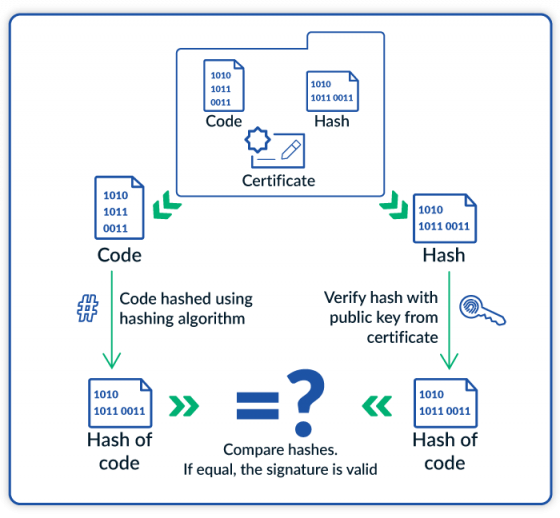
Code Signing Certificates enable software publishers to digitally sign applications, executables, scripts, and libraries, ensuring that the software remains untampered by external sources. Utilizing public key cryptography and code hashing, the signing process verifies the publisher's identity and confirms the software’s integrity. Without a valid digital signature, end users may receive security warnings or errors, potentially deterring installations.